We participate in affiliate programs, including Amazon Associates, and may earn commissions from qualifying purchases at no extra cost to you.
Smart Lighting Comparison
Table of Contents
ToggleSmart Switch vs Smart Bulb
Choosing between smart switches and smart bulbs can completely change how your smart lighting setup works day to day. The better option depends on your home, your wiring, and how you actually use your lights.
Updated May 2026 • Reviewed by Smart Home Guide Editors
Reviewed By Smart Home Guide Editors
Smart Lighting & Automation Review Team
Compared based on installation, reliability, automation, lighting control, and real-world usability.
Smart home technology has become more accessible than ever, and two of the most popular upgrades for homeowners and renters are smart switches and smart bulbs.
Both offer convenience, automation, and energy efficiency, but the better choice depends on your home setup, budget, and how you want to control your lighting.
If you're comparing product options, you can also explore our guides to best smart light switches and best smart bulbs for apartments .
Quick Answer
For most homeowners, smart switches are usually the better long-term option because they control entire rooms, work with physical wall switches, and feel more reliable daily.
For renters, beginners, or users wanting color-changing lighting, smart bulbs are often the easier and more flexible choice.
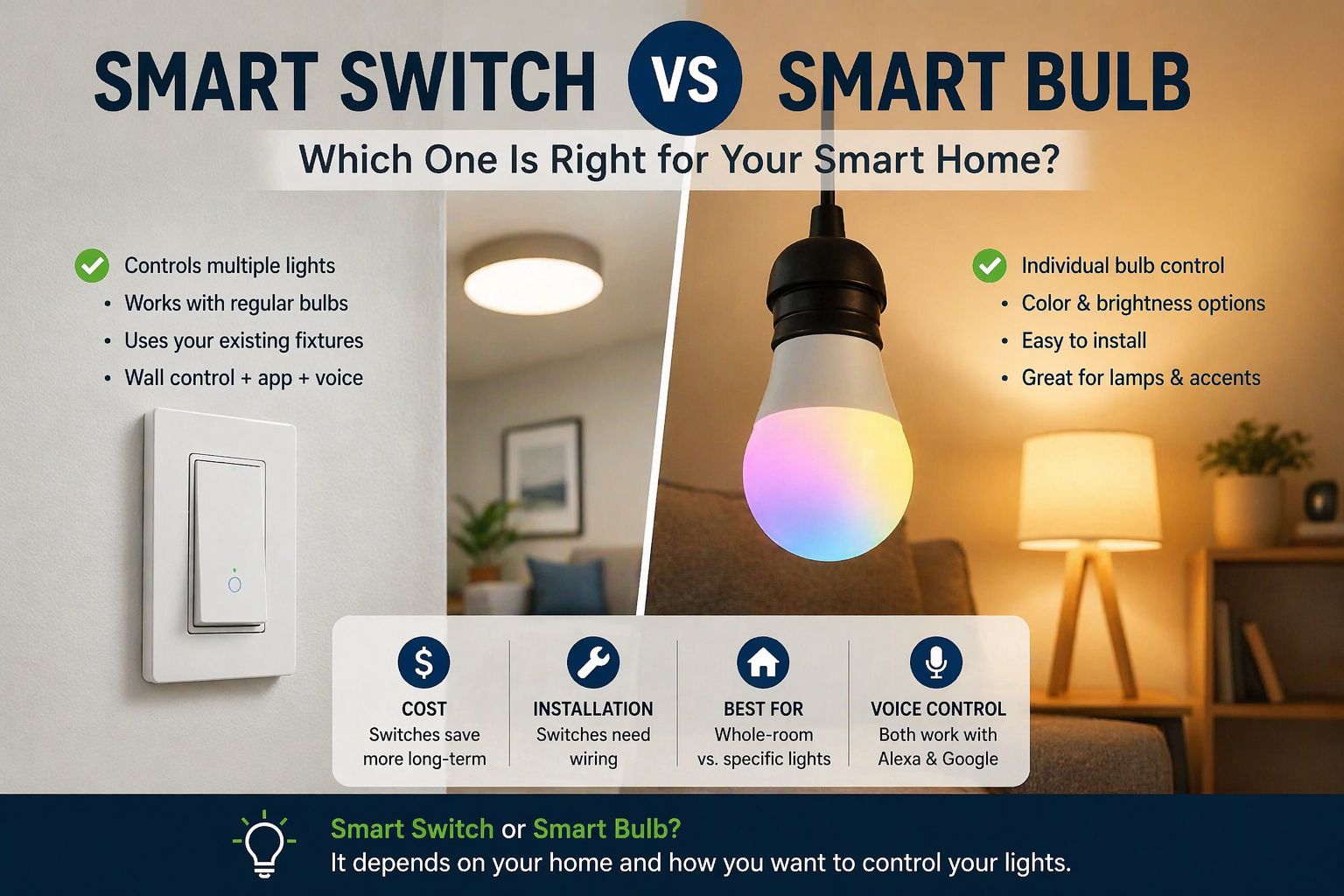
Smart Switch vs Smart Bulb Comparison
| Feature | Smart Switch | Smart Bulb |
|---|---|---|
| Installation | Requires wiring (may need neutral wire) | Simple screw-in installation |
| Control | Controls entire light circuit | Controls individual bulbs |
| Wall Switch Use | Works like normal switch | Must stay ON to work |
| Cost | Better for multiple lights | Cheaper per bulb but adds up |
| Features | Basic control and automation | Color changing, brightness control |
| Best For | Whole-room lighting | Accent and mood lighting |
What Is a Smart Switch?
A smart switch replaces your traditional wall light switch. It connects to your WiFi or smart home hub and lets you control your lights using an app, a voice assistant, or automation routines.
Once installed, a smart switch controls the power going to the light fixture itself. That means every bulb connected to that switch can be controlled together, whether you use standard LED, CFL, or incandescent bulbs.
If you want full-room lighting control, check out our guide to best smart switches for any home .
Key Features of Smart Switches
- Works with regular light bulbs
- Controlled through an app, voice assistant, or automation
- Physical wall control still works
- Ideal for whole-room lighting
What Is a Smart Bulb?
A smart bulb is a light bulb with built-in smart technology. Instead of replacing the wall switch, you simply replace the bulb itself.
Smart bulbs connect directly to WiFi or to a hub and can be controlled individually.
Smart bulbs are especially popular because they are easy to install and often include extra features like color changing and brightness control.
If you rent or want a no-wiring setup, see our guide to best smart bulbs for apartments .
Key Features of Smart Bulbs
- Simple screw-in installation
- Individual bulb control
- Color and brightness adjustment
- Often works without a hub
Smart Switch vs Smart Bulb: Key Differences
1. Installation
Smart switches require basic electrical wiring. In many homes, this includes a neutral wire, although no-neutral options are becoming more common.
Installation usually takes around 20 to 40 minutes and should always be done with the power turned off.
Smart bulbs are much easier to install. You simply screw them into a socket and connect them through an app.
This makes them ideal for renters or beginners who want a quick and easy upgrade.
Winner: Smart bulbs for ease of installation
2. Control and Convenience
Smart switches let you control all the lights on a circuit at once. The physical wall switch still works, so guests and family members can use it normally without confusion.
One thing many people do not realize initially is how frustrating smart bulbs can become when someone accidentally turns the wall switch off repeatedly.
Smart bulbs need the wall switch to stay on at all times. If someone turns the switch off, the bulb loses power and its smart features stop working.
Winner: Smart switches for everyday convenience
3. Cost Comparison
At first glance, smart bulbs usually seem cheaper because one bulb often costs less than one smart switch.
However, the cost can rise quickly if you need multiple smart bulbs in the same room.
A smart switch controls every bulb on the circuit, which often makes it more cost-effective for rooms with several lights.
Winner: Smart switches for multi-light rooms
4. Features and Customization
Smart bulbs are the clear winner when it comes to customization.
Many include RGB color changing, tunable white lighting, and built-in scene settings for different moods.
Smart switches focus more on automation, simplicity, and reliability instead of advanced lighting effects.
Winner: Smart bulbs for advanced lighting effects
5. Reliability and Stability
Smart switches are often more reliable because they are hardwired and do not depend on each bulb maintaining its own wireless connection.
Smart bulbs depend more heavily on wireless communication. If your WiFi becomes overloaded or unstable, you may notice delays or disconnects.
Winner: Smart switches for reliability
Best Setup for Different Users
Best for Renters and Apartments
Smart bulbs are usually the better choice because they do not require wiring changes and can easily be removed when you move out.
Best for Homeowners
Smart switches are ideal for permanent installations and whole-room lighting control.
Best for Color Lighting and Ambience
Smart bulbs are the better option for RGB lighting, mood settings, and decorative scenes.
Best for Families and Shared Homes
Smart switches are usually more practical because they work like normal wall switches and feel more natural for guests and family members.
Can You Use Smart Switches and Smart Bulbs Together?
Technically, yes, but it is usually not recommended unless the products are specifically designed to work together.
Using a smart switch with smart bulbs can create conflicts if power gets cut to the bulb repeatedly.
Energy Efficiency: Smart Switch vs Smart Bulb
Both smart switches and smart bulbs can help reduce energy usage through schedules, timers, and automation.
Most energy savings come from reducing unnecessary lighting rather than the devices themselves.
Why Trust Smart Home Guide
Smart Home Guide focuses on practical smart home recommendations for homeowners, renters, and beginners building connected home setups.
Our recommendations prioritize real-world usability, compatibility, reliability, and setup simplicity instead of just technical specifications.
Frequently Asked Questions
Are smart switches better than smart bulbs?
Smart switches are usually better for whole-room lighting control and shared homes, while smart bulbs are better for color lighting and renter-friendly setups.
Do smart bulbs work if the wall switch is off?
No. Smart bulbs lose power if the wall switch is turned off.
Do smart switches require wiring?
Yes. Most smart switches require basic electrical wiring and sometimes a neutral wire.
Final Verdict: Smart Switch or Smart Bulb?
There is no single answer that works for every home.
Choose smart switches if you want whole-room control, physical wall switch functionality, and stronger long-term reliability.
Choose smart bulbs if you rent, want color-changing lighting, or prefer easier installation.
For many homes, the best setup is honestly a combination of both.
Smart switches work extremely well for kitchens, hallways, and shared rooms, while smart bulbs are better for bedrooms, gaming setups, accent lighting, and mood scenes.
Ready to Upgrade Your Smart Home?
Explore our in-depth guides and comparisons to find the best smart switches and smart bulbs for your home setup.
At Smart Home Guide, the goal is to help you make smarter and more confident buying decisions without overcomplicating smart home technology.
According to the U.S. Department of Energy, smart lighting controls like smart switches and automated lighting systems can help reduce unnecessary energy usage by automatically turning lights off when not needed. You can learn more about energy-efficient lighting recommendations directly from the official Energy Saver guide here: Energy.gov Lighting Controls Guide .
2 thoughts on “Smart Switch Vs Smart Bulb: Which Is Better For Your Home?”