Smart Home Basics
Table of Contents
ToggleWhat Is a Smart Home Hub and Do You Need One?
A smart home hub helps connected devices communicate, automate routines, and work together more efficiently. But not every smart-home setup actually needs one.
Updated May 2026 • Reviewed by Smart Home Guide Editors
Reviewed By Smart Home Guide Editors
Smart Home Education Team
Smart-home hubs reviewed for compatibility, automation capabilities, ease of setup, reliability, scalability, and long-term smart-home performance.
If you're researching what is a smart home hub, you've probably noticed that some smart devices require a hub while others connect directly to WiFi.
This often creates confusion for beginners. Do you actually need a smart-home hub? Will it make your smart home better? Or is it simply another device that adds unnecessary complexity?
The answer depends on the type of smart-home system you want to build.
For some homeowners, WiFi devices are enough. For others, a smart-home hub becomes the central brain that helps everything work together more reliably.
What Is a Smart Home Hub?
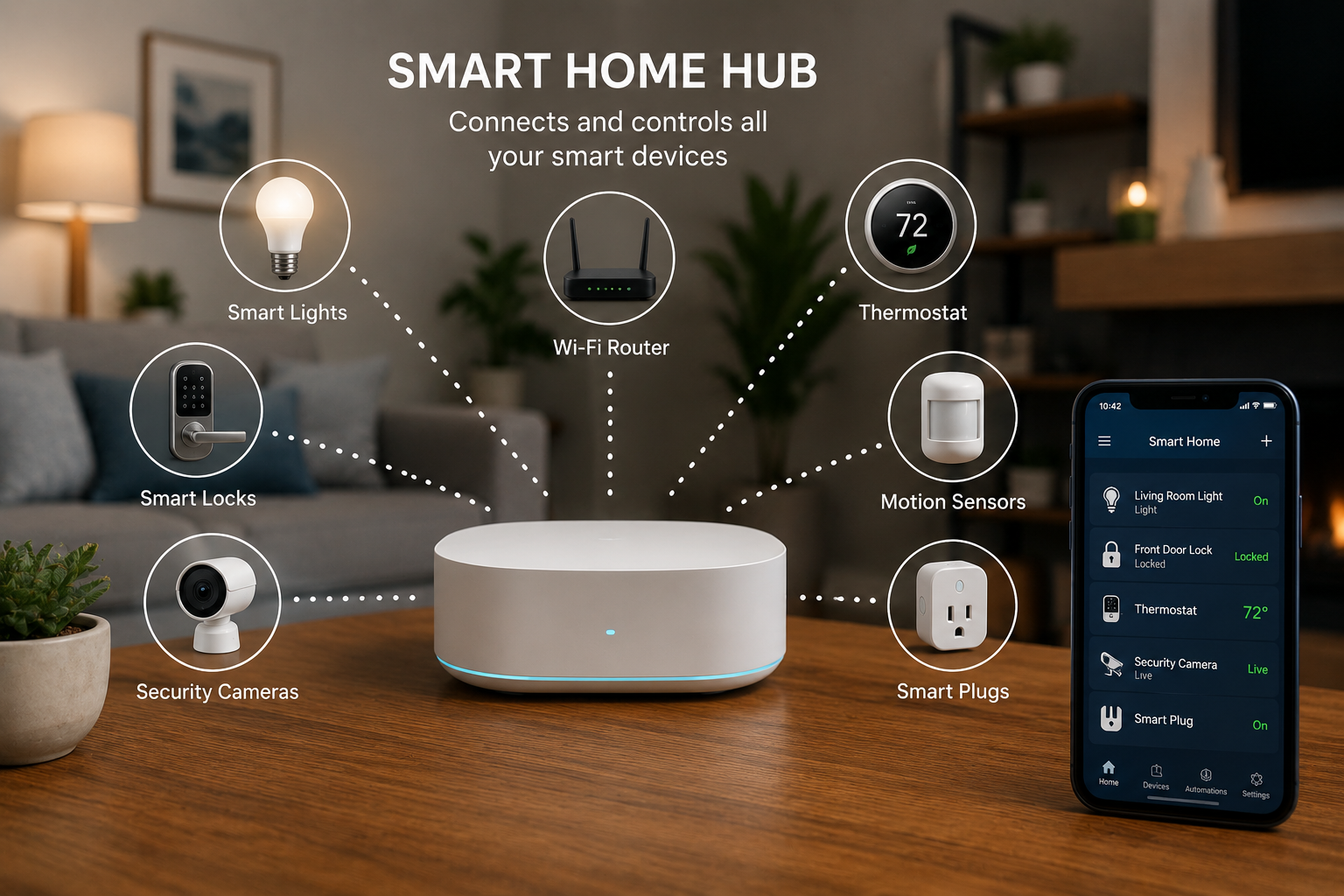
A smart home hub is a central device that connects, manages, and coordinates multiple smart-home products.
Instead of every device communicating independently, the hub acts as a control center that helps devices work together more efficiently.
Many hubs support communication protocols such as:
- Zigbee
- Z-Wave
- Matter
- Thread
- WiFi
- Bluetooth
This allows devices from different manufacturers to communicate through a single system.
What Does a Smart Home Hub Actually Do?
Think of a smart-home hub as a translator and manager for your smart devices.
- Connects compatible devices
- Runs automation routines
- Improves device communication
- Reduces WiFi congestion
- Centralizes device management
- Supports advanced automation
For example, a smart hub can automatically trigger lights, cameras, locks, and sensors to work together whenever a door opens.
Smart Home Hub vs WiFi Devices
Many modern smart devices connect directly to WiFi without requiring a hub.
Examples include:
- Smart plugs
- Smart bulbs
- Smart cameras
- Smart doorbells
- Smart speakers
These devices are often easier for beginners because setup is usually faster.
However, larger smart-home systems can become more difficult to manage when every device relies entirely on WiFi.
| Feature | Hub-Based Devices | WiFi Devices |
|---|---|---|
| Easy Setup | Moderate | Excellent |
| Advanced Automation | Excellent | Good |
| Scalability | Excellent | Moderate |
| Network Load | Lower | Higher |
When You Need a Smart Home Hub
A smart-home hub becomes more valuable as your smart-home system grows.
You may benefit from a hub if:
- You use many smart devices
- You want advanced automation
- You use Zigbee or Z-Wave devices
- You want devices from multiple brands working together
- You want a more scalable system
Many advanced smart-home users eventually add a hub because it improves reliability and automation flexibility.
When You Don't Need a Hub
Many beginners can start without a hub.
If you only use a few WiFi devices such as smart plugs, smart bulbs, or smart cameras, a hub may not be necessary initially.
You can always add a hub later as your smart-home setup expands.
Benefits of Using a Smart Home Hub
- Better automation capabilities
- Improved device compatibility
- Centralized smart-home control
- Reduced WiFi congestion
- Easier expansion in the future
- More advanced smart-home routines
Popular Types of Smart Home Hubs
Popular hub platforms include:
- Samsung SmartThings
- Amazon Echo Hub
- Apple Home Hub
- Hubitat Elevation
- Aqara Hub
If you're comparing specific models, visit our guide: Best Smart Home Hubs for Alexa and Google Home
If you're still learning the basics of connected devices and automation, our beginner guide explains how everything works together: How Does a Smart Home Work?
Why Trust Smart Home Guide
We focus on practical smart-home products and educational guides that help homeowners understand smart-home technology without unnecessary technical jargon.
Our recommendations prioritize compatibility, ease of setup, automation potential, reliability, and real-world usability.
How We Evaluate Smart Home Products
We focus on realistic smart-home usability instead of only technical specifications or marketing claims.
We evaluate products based on compatibility, automation capabilities, ease of setup, reliability, scalability, and long-term value.
Frequently Asked Questions
Do all smart-home devices need a hub?
No. Many modern smart-home devices connect directly to WiFi and do not require a hub.
What devices usually require a hub?
Many Zigbee and Z-Wave devices require a compatible smart-home hub to function properly.
Can a hub improve automation?
Yes. Smart-home hubs often provide more advanced automation options than standalone WiFi devices.
Should beginners buy a hub immediately?
Not necessarily. Many beginners can start with WiFi devices and add a hub later if their smart-home system grows.
Final Verdict
Understanding what is a smart home hub helps you decide whether a centralized smart-home system is right for your needs.
For small setups, WiFi devices may be enough. For larger smart homes with advanced automation, a hub can significantly improve device communication and overall system performance.
According to the Matter smart home standard , modern smart-home ecosystems are becoming easier to connect and manage across different brands, helping devices communicate more reliably through hubs and compatible platforms.