Smart Home Basics
Table of Contents
ToggleWiFi vs Zigbee vs Z-Wave: What's the Difference?
Understanding the differences between WiFi, Zigbee, and Z-Wave can help you build a smarter, more reliable smart-home system while avoiding compatibility issues.
Updated May 2026 • Reviewed by Smart Home Guide Editors
Reviewed By Smart Home Guide Editors
Smart Home Education Team
Communication technologies reviewed for reliability, range, speed, compatibility, automation support, and real-world smart-home performance.
When comparing zigbee vs z wave vs wifi, many smart-home beginners assume all smart devices connect the same way. In reality, these technologies work very differently and can significantly impact how your smart-home system performs.
Some devices connect directly to WiFi, while others rely on Zigbee or Z-Wave networks that communicate through a smart-home hub.
Choosing the right technology can improve reliability, reduce network congestion, and make automation much more effective.
Why Smart Home Devices Need Communication Protocols
Smart-home devices need a way to communicate with each other, your smartphone, and automation systems.
This communication happens through wireless protocols. Think of protocols as languages that devices use to exchange information.
The three most common smart-home communication methods are:
- WiFi
- Zigbee
- Z-Wave
Each has strengths and weaknesses depending on the type of smart-home system you want to build.
What Is WiFi?
WiFi is the most familiar wireless technology because it already powers internet access throughout most homes.
Many smart-home devices connect directly to your WiFi network without requiring additional hardware.
Examples include:
- Smart plugs
- Smart bulbs
- Smart cameras
- Video doorbells
- Smart speakers
WiFi devices are often the easiest for beginners because setup is usually simple and doesn't require a separate hub.
WiFi Advantages
- Easy setup
- No dedicated hub required
- High data transfer speeds
- Widely available
WiFi Limitations
- Uses more power
- Can overload busy networks
- Less efficient for large smart-home systems
What Is Zigbee?
Zigbee is a low-power wireless protocol designed specifically for smart-home devices.
Unlike WiFi, Zigbee devices typically communicate through a smart-home hub and create a mesh network.
In a mesh network, devices help pass signals between one another, extending overall coverage.
Common Zigbee devices include:
- Smart sensors
- Smart switches
- Smart locks
- Smart bulbs
Zigbee Advantages
- Low power consumption
- Strong mesh networking
- Supports many devices
- Excellent for automation
Zigbee Limitations
- Usually requires a hub
- Compatibility varies between brands
- Can experience interference with some WiFi frequencies
What Is Z-Wave?
Z-Wave is another smart-home protocol designed specifically for automation and connected devices.
Like Zigbee, it typically requires a smart-home hub and uses mesh networking.
However, Z-Wave operates on a different wireless frequency, which often reduces interference from WiFi networks.
Common Z-Wave products include:
- Smart locks
- Motion sensors
- Door sensors
- Smart switches
Z-Wave Advantages
- Excellent reliability
- Strong mesh network performance
- Low interference levels
- Broad smart-home compatibility
Z-Wave Limitations
- Requires a compatible hub
- Fewer products available compared to WiFi
- Usually costs more than WiFi alternatives
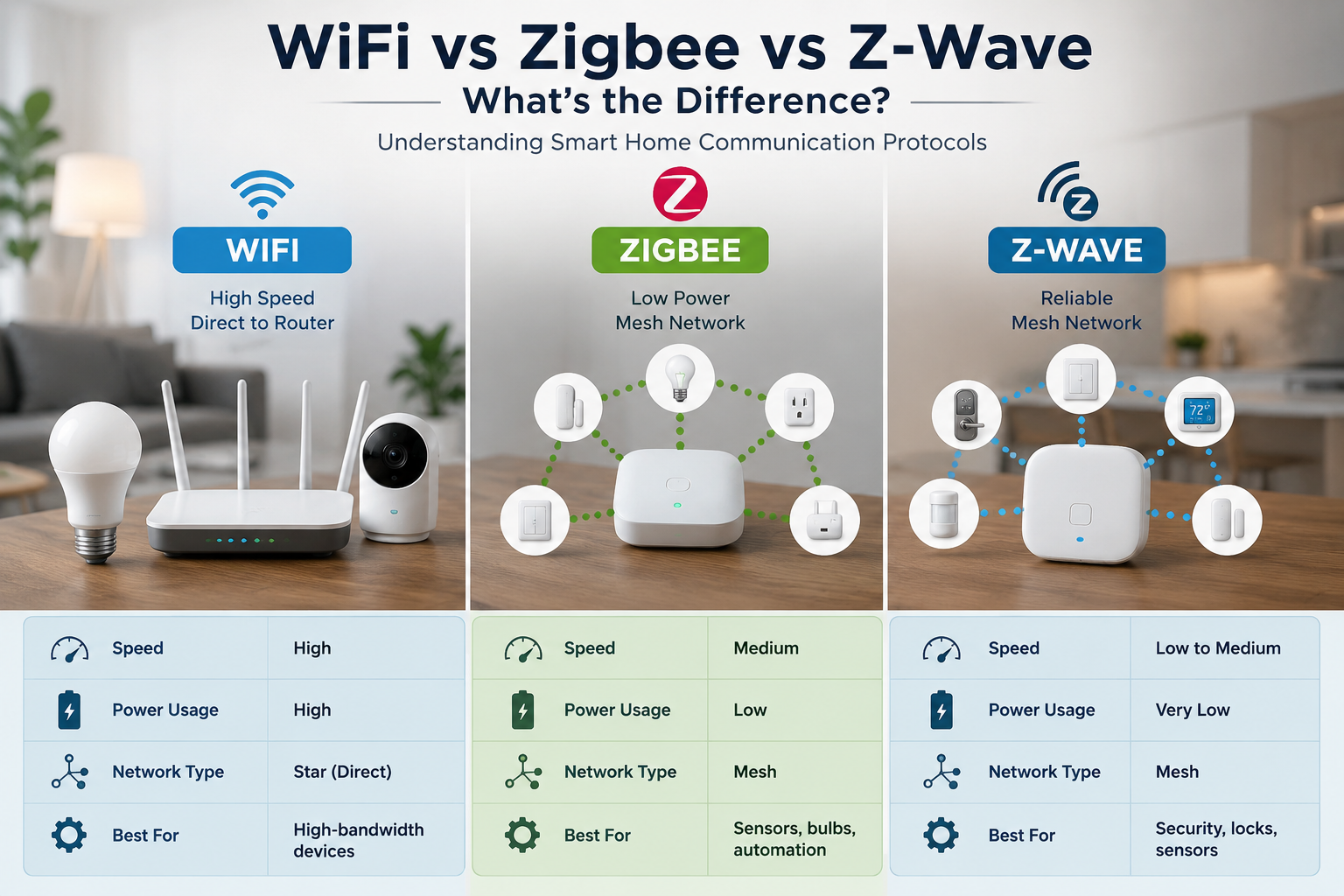
Zigbee vs z wave vs wifi
| Feature | WiFi | Zigbee | Z-Wave |
|---|---|---|---|
| Hub Required | No | Usually | Usually |
| Power Efficiency | Moderate | Excellent | Excellent |
| Mesh Networking | No | Yes | Yes |
| Best For | Small systems | Automation | Large smart homes |
| Beginner Friendly | Excellent | Good | Good |
Which Technology Is Best for Beginners?
For most beginners, WiFi devices are the easiest starting point.
They don't require a hub, installation is simple, and products are widely available.
If you're just learning how connected devices work, our guide can help: How Does a Smart Home Work?
Which Technology Is Best for Larger Smart Homes?
As smart-home systems grow, Zigbee and Z-Wave often become more attractive because they support larger device networks and advanced automation. zigbee vs z wave vs wifi
Many homeowners eventually add a hub to improve reliability and device communication.
If you're considering a hub-based setup, read: What Is a Smart Home Hub and Do You Need One?
Why Trust Smart Home Guide
We focus on practical smart-home education that helps homeowners understand technology before making purchasing decisions.
Our guides prioritize simplicity, compatibility, automation potential, reliability, and real-world usability rather than technical jargon alone.
How We Evaluate Smart Home Technology
We focus on real-world smart-home performance instead of marketing claims.
We compare technologies based on reliability, scalability, compatibility, ease of setup, automation capabilities, and long-term usability.
Frequently Asked Questions (zigbee vs z wave vs wifi)
Is Zigbee better than WiFi?
Not necessarily. Zigbee is often better for large smart-home systems and automation, while WiFi is usually easier for beginners.
Is Z-Wave better than Zigbee?
Both are excellent smart-home technologies. Z-Wave often experiences less wireless interference, while Zigbee generally supports a larger selection of products.
Do Zigbee devices require a hub?
Most Zigbee devices require a compatible smart-home hub for communication and automation.
Can WiFi and Zigbee devices work together?
Yes. Many modern smart-home platforms and hubs support both WiFi and Zigbee devices within the same system.
Final Verdict
When comparing zigbee vs z wave vs wifi, there is no single best option for every smart home.
WiFi is often ideal for beginners, while Zigbee and Z-Wave provide better scalability and automation capabilities for larger smart-home systems.
Understanding these technologies helps you build a more reliable and future-proof smart-home setup.
According to the Connectivity Standards Alliance (CSA) , Zigbee technology is specifically designed for low-power smart-home devices and large connected networks, making it one of the most widely adopted smart-home communication standards.