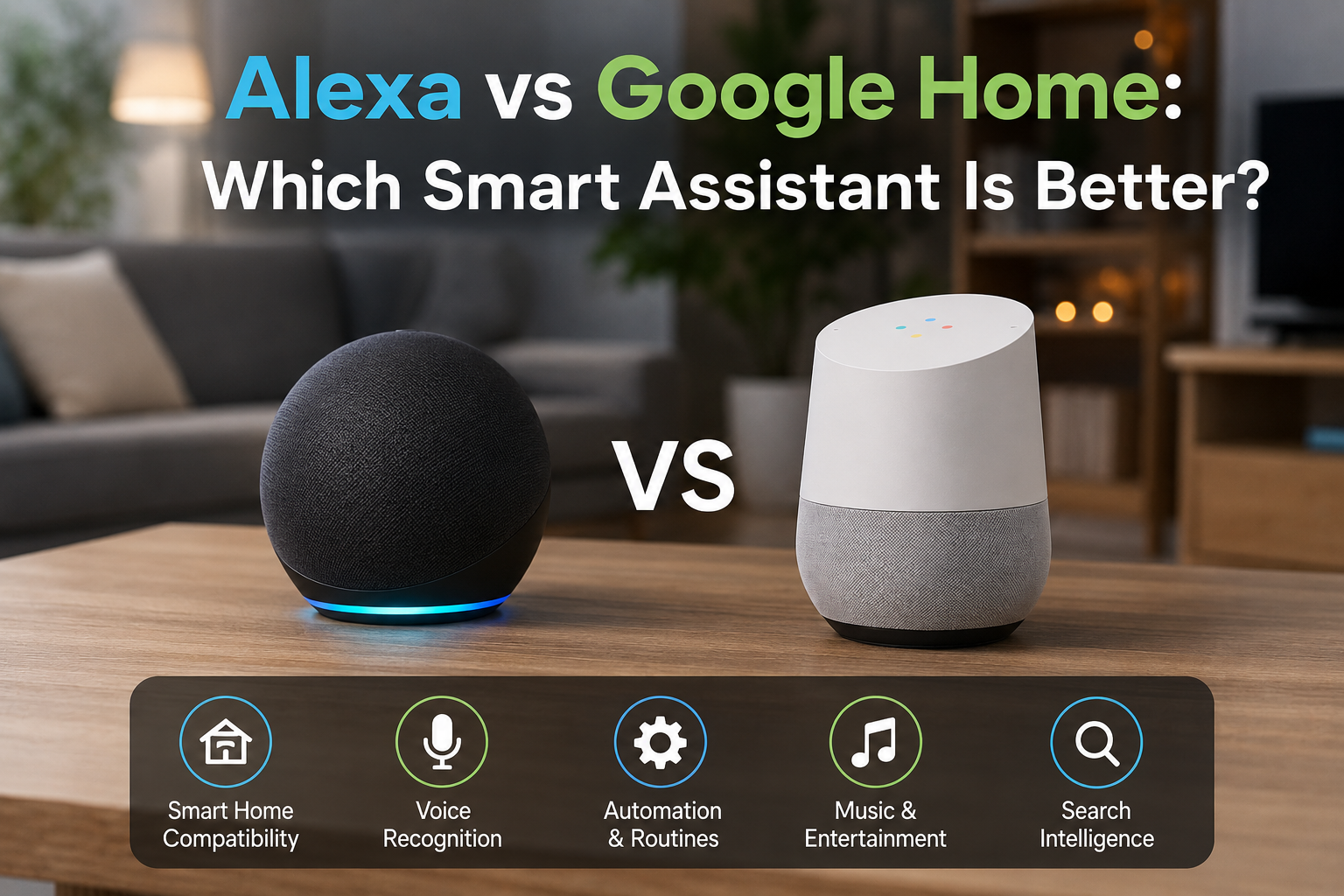
Voice Assistant Comparison
Table of Contents
ToggleAlexa vs Google Home: Which Smart Assistant Is Better? (Smart Guide)
Alexa and Google Home both offer smart-home automation, voice controls, music streaming, and connected-device management, but each ecosystem performs differently depending on your smart-home goals and daily usage.
Updated May 2026 • Reviewed by Smart Home Guide Editors
Reviewed By Smart Home Guide Editors
Smart Assistant Review Team
Smart assistants reviewed for automation flexibility, voice recognition quality, ecosystem compatibility, smart-home integration, entertainment features, and overall long-term usability.
The Alexa vs Google Home debate continues growing as more users build smart homes around voice assistants and connected automation systems.
Both Alexa and Google Home allow users to control smart devices, automate routines, stream music, manage schedules, and create voice-controlled smart-home environments.
However, the two ecosystems differ in smart-home compatibility, voice intelligence, automation flexibility, device ecosystems, and overall user experience.
For users planning to automate appliances and lighting, pairing your voice assistant with best smart home hubs for Alexa and Google Home can improve automation routines and voice-controlled convenience throughout your home.
Quick Comparison
- Best for Automation: Alexa
- Best for Voice Intelligence: Google Home
- Best Smart-Home Compatibility: Alexa
- Best Search and Questions: Google Home
Alexa vs Google Home Comparison
| Feature | Alexa | Google Home |
|---|---|---|
| Smart-Home Compatibility | Excellent | Very Good |
| Voice Recognition | Very Good | Excellent |
| Automation Flexibility | Excellent | Good |
| Search Intelligence | Good | Excellent |
| Entertainment Features | Excellent | Very Good |
Some links below are affiliate links. If you make a purchase, we may earn a commission at no additional cost to you.
Best Smart Assistant Picks
Alexa
Alexa is often considered the better smart assistant for advanced smart-home automation because it supports a massive number of smart-home products and automation routines.
It works especially well with smart plugs, smart lights, cameras, thermostats, sensors, and automation scenes across many smart-home brands.
- Excellent smart-home compatibility
- Strong automation routines
- Supports thousands of smart devices
- Easy voice commands
- Wide ecosystem support
Pros
- Excellent automation flexibility
- Very large smart-home ecosystem
- Strong voice-routine support
- Easy beginner setup
- Works with many smart-home brands
Cons
- Voice responses may feel less natural
- Privacy concerns for some users
- Requires internet for most features
Google Home
Google Home is often viewed as the smarter voice assistant because it uses Google Search intelligence to answer questions more naturally and accurately.
It performs especially well for general knowledge questions, voice searches, calendar management, and Google ecosystem integration.
- Excellent search intelligence
- Natural voice conversations
- Strong Google ecosystem integration
- Easy voice controls
- Reliable smart-home support
Pros
- More natural voice interactions
- Excellent Google Search integration
- Strong voice recognition accuracy
- Simple beginner experience
- Very good smart-home controls
Cons
- Smaller automation ecosystem than Alexa
- Fewer advanced routines
- Some smart-device compatibility limitations
Why Trust Smart Home Guide
We focus on practical smart-home products that improve automation, convenience, voice controls, and realistic everyday usability.
We compare smart assistants based on automation flexibility, voice recognition quality, smart-home compatibility, ecosystem integration, and overall long-term usability.
Benefits of Smart Assistants
The Alexa vs Google Home comparison highlights how voice assistants improve convenience, automation, entertainment, and connected smart-home management.
One major advantage is hands-free control. Users can control smart devices, ask questions, stream music, and manage routines using simple voice commands throughout the home.
Smart assistants also simplify automation by allowing devices like smart lights, plugs, thermostats, and cameras to work together more efficiently.
Voice assistants improve convenience for everyday tasks such as turning lights on and off, checking schedules, controlling temperatures, and managing entertainment systems.
Another major advantage is ecosystem integration. Alexa works especially well with Amazon products, while Google Home integrates strongly with Google services like Gmail, Calendar, and Google Search.
What to Look for Before Choosing
Smart-home compatibility is important because Alexa generally supports more smart-home brands and automation products.
Google Home usually provides more natural voice conversations and stronger search intelligence for questions and information requests.
Alexa offers stronger automation flexibility for users building larger smart-home systems with advanced routines and automation scenes.
Entertainment preferences also matter because streaming services and ecosystem integration may differ depending on your subscriptions and devices.
Privacy settings, microphone controls, and voice recording management should also be reviewed before choosing a smart-assistant ecosystem.
How We Evaluate Smart Assistants
We focus on realistic smart-home usability instead of only technical specifications or marketing claims.
We evaluate smart assistants based on automation flexibility, voice intelligence, ecosystem compatibility, smart-home integration, entertainment features, and overall long-term usability.
Frequently Asked Questions
Is Alexa better than Google Home?
Alexa is generally better for advanced smart-home automation, while Google Home performs better for voice intelligence and search functionality.
Which smart assistant is best for beginners?
Both Alexa and Google Home are beginner friendly, although Alexa often provides stronger smart-home compatibility for connected devices.
Can Alexa and Google Home work together?
Some smart devices support both ecosystems, although Alexa and Google Home do not directly integrate together.
Do smart assistants require WiFi?
Yes. Most smart-assistant features require internet connectivity for voice processing and automation controls.
Final Verdict (Alexa vs Google Home)
The Alexa vs Google Home comparison ultimately depends on your priorities. Alexa is usually the better choice for advanced smart-home automation and larger smart-device ecosystems, while Google Home offers stronger voice intelligence, search integration, and more natural conversations.
For users planning to automate lighting, appliances, and connected routines, pairing your assistant with best smart home hubs for Alexa and Google Home can improve voice-controlled automation and connected-home convenience.
Build Your Smart Assistant Setup